



































Essential Steps on How to Start an Event Venue Business
 SHELTENT
-
SHELTENT
-


With demand for offline events, weddings, corporate gatherings, and brand launches on the rise, the event venue business is quickly becoming a promising long-term opportunity. Unlike one-off projects, event spaces can be used again and again, generating steady cash flow once they’re up and running. Venues can be quite profitable, though earnings really depend on factors like location, target clients, and the type of events hosted.
Industry research shows that the average profit margin for venue owners is around 10% to 20%, and in high-demand areas, it can even reach 60%. If you want to take advantage of this opportunity, a solid event venue business plan is the first step. Let’s dive into how to launch and run this business efficiently.
Essential Steps for Starting an Event Venue Business
The selection of customer groups, the determination of venue type, and the arrangement of operation methods can all affect future profitability. Next, we will guide you through the process of successfully launching an event venue, from market research and venue design to daily operations.
Do Market Research
Get your market research and cost data in order. They’ll help you get a clearer sense of the market and provide a reliable reference when choosing and planning your venue. Before you decide to rent or build a space, you need to see if there’s actually demand in your area.
Start by checking out your competitors, and see what services and types of events they offer, and look for gaps in the market. Pay attention to what potential clients want for weddings, corporate events, celebrations, or specialty events, and figure out where you can fit in.
You should also look at the local population, the location of nearby hotels and attractions, and how many venues are already around to judge if the market is big enough. Don’t forget to talk to event planners, caterers, florists, and photographers. Their experience can give you lots of practical advice.
Getting in touch with industry associations like NACE (National Association for Catering and Events) or WIPA (Wedding Industry Professionals Association) can also get you industry data, certifications, and connections with other venue operators.

When it comes to pricing and costs, start by checking what competitors charge and the types of clients they serve, whether it’s high-end weddings or budget-friendly family gatherings. Then figure out your own costs, including rent, utilities, staff, insurance, marketing, and other expenses, and compare them to your expected revenue to see if it’s feasible.
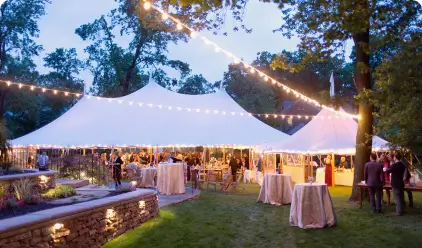
Many entrepreneurs worry about high rent and long-term leases when looking for a venue, so you might consider using an event tent to set up an outdoor space. It can lower upfront costs and give you flexibility to handle different types of events.
Define Your Type of Event Venue and Concept
Before you pick a venue or set a budget, think about what kind of events you want to host.
- Will you focus mainly on party weddings, corporate events, private dinners, social celebrations, or a mix?
- What kind of atmosphere are you aiming for, such as a modern loft, rustic barn, garden resort, or a formal ballroom?
These choices will affect your design, operations, and the experience your clients have.
Besides basic rentals, consider ways to generate income during the off-season, like hosting concerts, exhibitions, or small markets. At the start, it is smart to focus on one niche to keep operations manageable and then expand gradually as you gain experience and resources.
By the way, finding something that sets you apart from competitors will help attract your target clients and make your venue easier to book. Think about what matters to your clients. Their needs will shape your services and positioning. Also consider what makes your venue unique. Is it the design, location, facilities, or full-service catering?
Create a Solid Business Plan
Creating a business plan helps you clarify the direction of your entire event venue business and enhances your professionalism and persuasiveness when you need to raise funds or communicate with partners. A business plan typically includes the following parts:
-
Overview and Objectives: Clearly state what you intend to do, why you are doing it, and what goals you aim to achieve in the coming years.
-
Market and Competitive Analysis: Use prior research data to illustrate local demand, competitive landscape, and the customer segments you plan to serve.
-
Operational Framework: Describe your business model, including services offered, required equipment, and staffing arrangements.
-
Marketing Strategy: Outline how you plan to promote your venue to target customers, including online advertising, collaborative promotions, and grand opening events.
-
Financial Plan: List projected expenses and revenue, including renovation/rent, equipment, daily costs, and estimated income. Use a simple income-expense comparison to determine when costs will be covered.
It's worth mentioning that you need to calculate the costs and estimate the profits yourself. Even if you are starting from scratch and have no start-up capital, you still need to identify your sources of income, such as rental income, additional service fees, etc. This will help you adjust your plans or find partners for support.
Take Care of Business Legal
Taking care of legal matters and insurance early can help you avoid problems down the road. Start by thinking about your business structure. Will you go with a sole proprietorship or a limited liability company (LLC)? A sole proprietorship is easy to set up, but you are personally responsible for all business debts.
An LLC protects your personal assets, so you won’t be on the hook for company liabilities. Once you’ve chosen a structure, register your event venue business name and complete the necessary paperwork as soon as possible. This way, you have legal protection before buying assets or signing contracts.
Next, make sure to get all the required permits and licenses. This includes state and local business licenses, sales permits, liquor licenses, and inspections for fire and building safety. Requirements vary by location, so you can check with local small business development centers, an attorney, or your state’s Secretary of State office.
Common insurance policies include:
- General Liability Insurance
- Professional Liability Insurance
- Commercial Property Insurance
- Workers' Compensation, Unemployment, and Disability Insurance (mandatory under federal law if you have employees)
Select the Right Location
When choosing a location for your event venue, think about how convenient it is for guests, the parking situation, and possible noise issues. You don’t have to start with a large commercial space. Sometimes, your own backyard, a friend’s farm, or other free spaces can be enough, and it can save you a lot on rent.

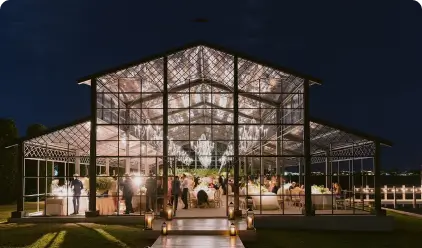
If you want to turn an empty lot into a usable event space temporarily, tents can be a very practical solution. For example, a clear span tent is ideal if you want a reasonably large space or even plan to use it long-term. These tents have no internal poles, so the interior is completely open, giving you freedom to set up stages, tables, and other decorations. The PVC fabric is waterproof and flame-retardant to ensure safety and smoothness.
Its modular design means that you can adjust the span width or extend the length to fit different event sizes. The frame is usually made of high-strength aluminum, making it strong against wind and rain.

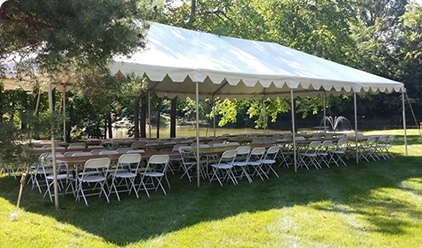
If you don’t want a permanent setup for now, a frame tent is another good option. It's a simple temporary structure that is supported by a sturdy aluminum frame without internal poles.
It has a modular design that allows you to expand by connecting different sections depending on the number of guests and layout. It can be set up on grass, concrete, or other surfaces. The materials are also waterproof, UV-resistant, and flame retardant. Installation and takedown are simpler than a clear span tent, and it is suitable for short-term events, markets, or outdoor gatherings.
Set up Event Space
Once you have the event business venue, the real work is figuring out how to make the space actually work. Many issues don’t show up on floor plans and only become clear after you’ve hosted a few events. If the layout is too fixed and only works for one type of event, it can easily limit you later. That’s why it’s better to keep the space flexible, so tables, seating areas, and guest flow can be adjusted for different events.
Lighting and sound don’t need to be complicated, but they do need to work well. Being able to change the atmosphere quickly and handle different crowd sizes matters more than having high-end equipment. And one thing you really shouldn’t overlook is practical spaces like restrooms, back-of-house work areas, and storage.
You also don’t need to buy all your equipment at once. Rent or the venue itself already takes up a big part of your budget, and everything else can be added over time. After running a few events, it becomes clear what you use all the time and what you only need occasionally.
In the early stage, rent what you can and keep your budget focused on the essentials. Once your operation runs smoothly, you can improve and upgrade gradually, which makes the whole process much easier.
🎈You May Also Read: 5 Tips on How to Start a Party Rental Business
Market Your Business
Before you officially open, the most important thing is letting people know the venue exists and is available to book. Many venues don’t struggle because of their space or setup, but because no one knows about them.
Online channels are usually the fastest way to work. Set up a basic website, create social media accounts, and make sure your venue information is complete on Google so people who are actively searching can find you.
You can also combine this with some local exposure, such as putting up posters in high-traffic areas or running small ads through local media or social platforms to get your name out there.

Beyond reaching clients directly, building relationships with local event planners, photographers, caterers, and decor vendors can be even more effective. They already have steady access to clients, and if working together goes smoothly, referrals often work better than ads.
Another smart move is to lower the barrier for first-time bookings. In the early stage, offering discounts or bundled packages can help fill up your calendar faster. Every early event is worth taking seriously, because real experiences and client feedback are far more convincing than any promotional copy.
Manage the Pricing
Before setting your prices, you need to get your numbers straight. The cost of starting an event venue can vary a lot. It depends on the city, the size of the space, and how you position it. Startup costs can range from tens of thousands of dollars to several hundred thousand, or even more.
Beyond one-time upfront expenses, you also need to account for ongoing monthly costs like utilities, maintenance, cleaning, insurance, taxes, staffing, and continuous marketing.
All of these factors shape the minimum price range you can realistically charge
Once you have that baseline, pricing decisions become much more grounded. Early on, it usually makes sense not to price too high, especially before you have real bookings and reviews.
Offering more approachable pricing or bundled packages can help bring in your first clients and fill your calendar faster. As bookings become more consistent, you can gradually create price differences based on event types and service levels, see what performs best, and adjust over time.
What If You Want to Start an Event Venue Business with No Money?
To be honest, starting an event venue with zero investment is extremely difficult. Venue costs, equipment, and basic operating expenses all require money. Unless you’re just offering a piece of land to clients who bring all their own equipment, zero-cost is more of an ideal than a reality. In most cases, you’ll need at least some startup funds, though the amount can vary.
If your budget is limited, a more realistic approach is to focus on spending as little as possible rather than nothing at all. Start small, get your operations running, and gradually reinvest the income back into the event venue business. You can also consider bringing in funds from friends, family, or partners, as long as you clearly explain the return instead of just borrowing money.
You don’t necessarily need to sign a long-term lease for your venue right away. Partnering with existing spaces is a common approach. You could use the venue during their off-peak hours or arrange a resource swap to cut costs. Some venues might even provide space rent-free, taking a share of beverages or other revenue instead. The key is finding an arrangement that works for both sides.
Overall, starting this type of business with limited funds requires patience and flexibility. Spend less upfront and focus more on phased trials. This makes it much easier to get through the early stages.
Tips on Successful Event Venue Business
Running an event venue isn't just about renting space and buying equipment. What truly drives sustained business growth is daily management and optimization, ensuring both clients and your team feel comfortable and efficient. These tips will help make your venue more efficient and popular.

-
Build a Reliable Team: Hire the right people and clearly define responsibilities, ensuring every process has a designated owner.
-
Host a Launch Event: Before officially opening, organize an open house inviting event planners, vendors, media, and even potential corporate clients to experience your venue. A successful open house not only yields great photos but also builds word-of-mouth and future bookings.
-
Gather Feedback and Improve Continuously: Treat every event as a learning opportunity. Ask clients what they liked and disliked, and maintain open communication with vendors and staff. Adjust layouts, signage, amenities, or operational processes based on real-world usage.
-
Focus on Profitability: Track revenue from different event types to identify the most profitable ones. Prioritize optimizing related services and packages accordingly.
Open a Tented Event Space with Sheltent
Whether you already have a venue or plan to rent a commercial space, using tents for events is an effective way to cut costs, stay flexible, and get your business running quickly. It’s also a safe approach if you want to scale up gradually, thanks to the scalability of event tens. Compared to building a permanent venue or signing a long-term lease, tents significantly reduce upfront investment and avoid high ongoing rent.
At Sheltent, our modern event tents are modular, so you can adjust the space to fit the size of your event. They can be set up quickly, saving weeks or even months compared to traditional construction. The materials are durable and the structure is sturdy, allowing multiple setups and takedowns without damage. They can also handle different weather conditions, keeping events safe and running smoothly.
Sheltent's tents also offer high flexibility in layout. You can divide the space according to the type of event, set up lighting, sound, stages, and catering areas, and create the best experience for every occasion.
Conclusion
Starting an event venue business can be challenging, but with proper market research, clear positioning, smart layout design, well-planned operations and pricing, and a focus on promotion and customer service, you can build a stable and sustainable profit model. Throughout the process, location, flexible space planning, and an efficient team are key factors for success.
If you want to get your business running quickly while keeping costs low and staying flexible, using a frame tent can save you a lot of hassle. If you’re looking to set up a high-quality, safe, and reliable space for your next event, contact Sheltent for professional tent solutions.


